There is much excitement among non-residents about leveraged FCNR deposits.
Banks are reaching out to NRI investors (and vice versa) to make the most of a limited window until September 30, 2026.
How Leverage FCNR Deposits work?
- You put USD 100,000 down.
- Against this USD 100,000 deposit, the bank lends USD 900,000. At say 5.5% p.a. 9X leverage.
- You put the full USD 1 million in a 5-year FCNR deposit at 6% p.a.
- After 5 years, FCNR deposit matures, and the proceeds are used to square off the loan and the remaining amount flows to you.
- Over 5 years, this 9X leverage and small spread (6% on FCNR vs 5.5% on loan) takes the IRR on your original investment (USD 100,000) to about 10% to 12% p.a.
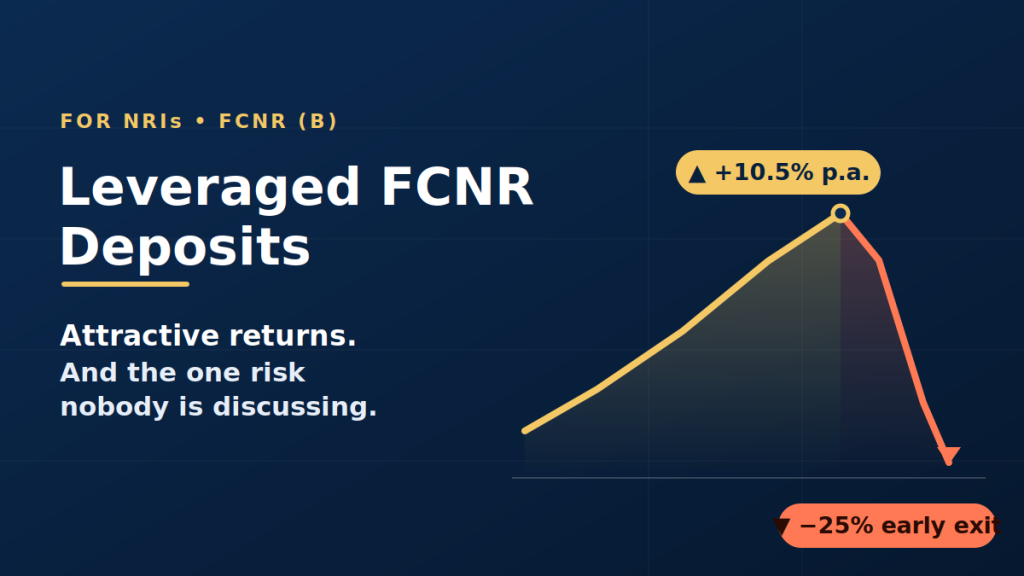
- In this specific case, you would end up with ~ USD 164,000. About USD 64,000 in profits (on your USD 100,000 capital). ~10.5% p.a.
- This is equity like return. In USD (and not INR). At seemingly no risk.
- And this explains the rush behind this product.
However, there is a real risk in some corner cases that nobody is talking about.
Consider a morbid scenario.
- The investor passes away just 2 years into this product.
- The bank asks the family to close the loan, or alternatively winds down the entire structure as soon as it is intimated about investor demise. So, both FCNR deposit and the loan structure must be closed.
- Now, the loan interest rate remains unchanged. At 5.5%.
- But the FCNR earns a much lower interest rate because of premature closure. The investor gets the rate applicable for the period the deposit actually stayed, not the 5-year rate contracted.
- The bank may even waive the premature-closure penalty on death. But that is not where the damage is. The damage is the rate reversal, while the loan keeps running at 5.5%.
- For instance, ICICI Bank offers 3.85% on 2-year FCNR deposit. And 6% on 5-year FCNR deposit.
- Loan at 5.5% p.a. Returns at 3.85% p.a. 9X leverage.
You know this is headed for disaster. Or rather the family is.
Leverage cuts both ways. If you get this right, it amplifies returns. If it backfires, it can seriously damage your capital.
In this case, you (your family) get back only about USD 75,000. You had invested USD 100,000. USD 25,000 or 25% of capital gone. And this is with capital of USD 100,000. What if you had put more?
Further, the bank may also pass on the cost of unwinding interest rate swap (IRS) on to the family. It may have entered into IRS to offer you a fixed rate loan.
Now, there may be gaps in my understanding. I may not have understood the product structure properly.
However, if you are interested in such a product, do speak to your bank and understand how this facility would behave in such edge cases.
It becomes even more important because of the insane amount of leverage involved. In such corner cases, you must not worry just about lower returns, but also about serious erosion of capital.
You owe this to your family.
Disclaimer: Registration granted by SEBI, membership of BASL, and certification from NISM in no way guarantee performance of the intermediary or provide any assurance of returns to investors. Investment in securities market is subject to market risks. Read all the related documents carefully before investing.
This post is for education purpose alone and is NOT investment advice. This is not a recommendation to invest or NOT invest in any product. The securities, instruments, or indices quoted are for illustration only and are not recommendatory. My views may be biased, and I may choose not to focus on aspects that you consider important. Your financial goals may be different. You may have a different risk profile. You may be in a different life stage than I am in. Hence, you must NOT base your investment decisions based on my writings. There is no one-size-fits-all solution in investments. What may be a good investment for certain investors may NOT be good for others. And vice versa. Therefore, read and understand the product terms and conditions and consider your risk profile, requirements, and suitability before investing in any investment product or following an investment approach.