


You retire at 58. On your last working day, your EPF account shows Rs 50 lacs. Perhaps the largest sum of money you have ever seen in your bank account.
What do you do with it?
Until now, you did not have much of a choice. You had to withdraw the entire corpus lumpsum and figure out the rest yourself.
That may be about to change. On 19 November 2026, the Central Board of Trustees (CBT), EPF approved a major change to how you can utilize your EPF corpus at the time of retirement. Taking a cue from systematic withdrawal plans (SWP) in mutual funds, the board has approved SWP from the EPF corpus too. So, you get an option to withdraw your EPF corpus in periodic installments.
In this post, let us look at what we know about EPF SWP, what we don’t know yet, how the payouts may be taxed, and how much monthly income an EPF corpus can support. And whether this makes EPF as good a pension tool as PPF.
First, what is an SWP?
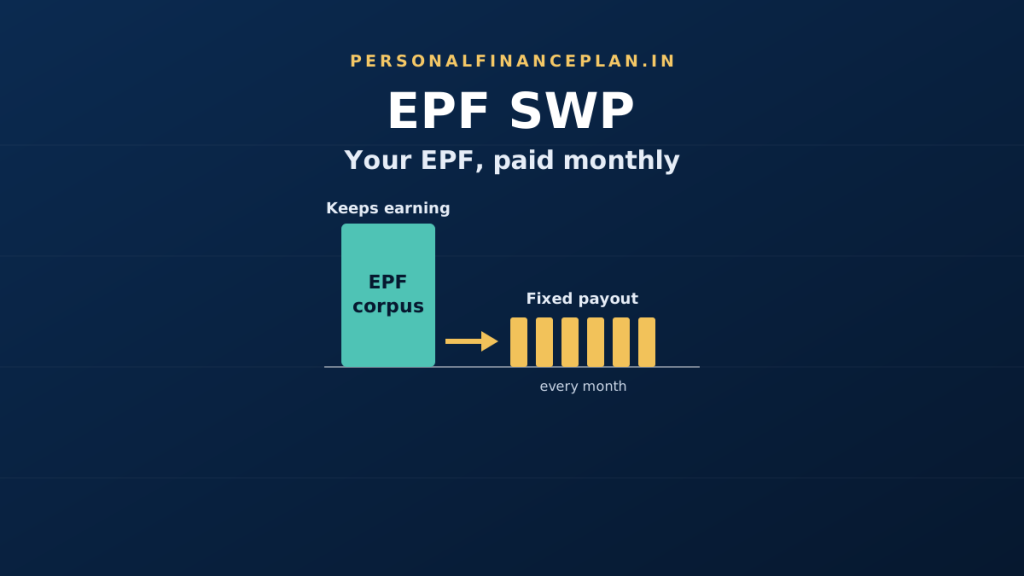
A Systematic Withdrawal Plan (SWP) is an arrangement where you withdraw a fixed amount from your investment at regular intervals, while the balance stays invested and keeps earning returns.
In mutual funds, SWP is a popular way to generate retirement income. EPF SWP applies the same idea to your EPF corpus. Instead of taking all the money out on the day you retire, you leave it with EPFO and receive a fixed amount every month (or quarter, or half-year).
Note that an SWP is NOT a pension or an annuity. It does not guarantee income for life. Nor does it guarantee a fixed interest rate. You are only getting your own money back in installments, along with the interest it continues to earn. If you withdraw too much, the corpus can run out.
Is EPF SWP available right now?
No.
The CBT has only approved the proposal. As per the official press release, the amendments to the EPF scheme will be notified after approval from the Labour Ministry. Separately, a corresponding amendment to the Income Tax Act is being taken up with the Ministry of Finance. No launch date has been announced.
Hence, if you are retiring in the next few months, do not plan around EPF SWP yet. However, if you do not need the money right away, you can leave your EPF corpus with EPFO for a few more months and hope for this change to be notified soon. The corpus continues to earn interest in the meantime (though this post-retirement interest is taxable). Note that we do not know yet whether SWP will be available to members who have already retired.
You can read the official PIB press release here.
What we know about SWP in EPF
- Available to retiring members. In the initial phase, about 6.32 lacs members aged above 55 with EPF balance of more than Rs 5 lacs are expected to be the primary beneficiaries. Members retiring in the future can opt for it too.
- Voluntary. You can still opt for lumpsum withdrawal. There is no compulsion.
- Monthly, quarterly, or half-yearly installments, based on your preference.
- The corpus continues to earn interest while you receive installments.
- Protection for the family. If the member passes away during the payout period, the nominee or dependent can either withdraw the remaining balance or continue to receive periodic payments. The option may also be extended to eligible family members/beneficiaries.
How much monthly income can an EPF corpus support?
Let us put some numbers to this.
Assume you retire with an EPF corpus of Rs 50 lacs and opt for monthly installments. Assume EPF continues to pay 8.25% p.a. (the rate for FY2025-26) even after retirement. EPF calculates interest on the monthly running balance and credits it once a year.
| Monthly payout | Annual payout | Corpus after 10 years | How long the corpus lasts |
| Rs 30,000 | Rs 3.6 lacs | Rs 55.3 lacs | Never runs out. The corpus keeps growing. |
| Rs 35,000 | Rs 4.2 lacs | Rs 46.1 lacs | ~35 years |
| Rs 40,000 | Rs 4.8 lacs | Rs 37 lacs | ~22 years |
| Rs 50,000 | Rs 6 lacs | Rs 18.6 lacs | ~13.5 years |
Pre-tax numbers. Assumes a constant 8.25% p.a. interest rate. Interest computed on monthly running balance and credited annually.
Look at the difference between Rs 35,000 and Rs 50,000 per month. An extra Rs 15,000 per month cuts the life of the corpus from 35 years to under 14 years. If you retire at 58, Rs 50,000 per month runs out by your early 70s. The withdrawal amount you choose matters a lot.
Note that these numbers ignore taxes and assume the interest rate does not change. Do not trust the data blindly. The EPF interest rate is decided every year and can go down. Moreover, we do not know yet whether the post-retirement corpus will earn the same rate (more on this below).
What we don’t know yet
- Is the option available only at the time of superannuation (retirement)? Or will anyone who wants to exit EPF have this option? For instance, will this option be available if a subscriber decides to exit EPF at the age of 45?
- Who decides the installment amount? Can you choose any amount you want, or is there a cap on withdrawal? Can you change the amount or frequency later?
- Is there a maximum age until which you can receive installments?
- Flexibility: If you have once opted to receive periodic installments, can you opt to receive lumpsum later? You should be able to, but we need to know the exact modalities. You do not want to lose control/access to your own money once you opt for SWP.
- Does the corpus (after retirement) earn the same rate of interest as the EPF corpus (before retirement)? It should be the same. However, the press release also talks about the long-term sustainability of the fund. Hence, I would wait for further details. It is possible that the post-retirement corpus earns a lower rate of interest.
- Will members who have already retired be eligible? For instance, if you retired in October 2026 and have not withdrawn your EPF yet, can you opt for SWP once it is notified? Or is it only for those who retire after the notification?
How will these periodic payouts under EPF be taxed?
This is the most important open question.
Let us first understand the current position.
The final EPF withdrawal at retirement is tax-free (provided you have completed 5 years of continuous service). The problem is with money you leave in the account after retirement. As I understand, under current tax laws, the interest earned on EPF after retirement is taxable. There is nothing in the current law that makes such interest tax-exempt.
Even currently, your own contribution to EPF is divided into 2 parts. And EPFO maintains these as two separate accounts.
- Exempt EPF: Your own contribution (EPF + VPF) up to Rs 2.5 lacs per annum (Rs 5 lacs if your employer does not contribute). Interest on this portion is exempt. However, even such interest is exempt only until retirement.
- Taxable EPF: Your own contribution above this limit. Interest on this portion is taxable every year, and EPFO deducts TDS on it. And since this interest gets added to the taxable EPF corpus, the interest earned on that interest in the following years is taxable too.
Employer contribution works differently. If your employer’s contribution to EPF, NPS, and superannuation fund put together exceeds Rs 7.5 lacs in a year, the excess is taxable in your hands as a perquisite. So is the interest on that excess (including interest on interest). Here, your employer calculates this amount and deducts TDS from your salary.
The press release says that a corresponding amendment to the Income Tax Act is being taken up with the Ministry of Finance. We do not know what that amendment will say. It could make post-retirement interest under SWP tax-free. Or it could simply clarify how such interest will be taxed.
What happens if you decide to take this SWP option?
Does the Exempt EPF also become taxable after retirement? What portion will be debited for your periodic payments? Exempt EPF or Taxable EPF or Employer portion?
How will it be decided what portion of your monthly (quarterly/half-yearly) payout is the contribution (that won’t be taxed) and how much is interest (this will likely be taxed)? The answer can be quite simple, but we must have clarity.
Consider SWP in mutual funds. Every payout is a mix of principal and capital gain. Principal is not taxed. Only the capital gains portion is taxed. I don’t think this route will be taken for EPF. Seems unnecessarily complex.
My sense is that, if you opt for the SWP option, all the portions (exempt and taxable portions of your share and your employer’s share) will be clubbed into a single corpus. And the interest earned on this corpus will be taxable at your slab rate. You pay tax on this interest every year. EPFO may also deduct TDS on it, just as it does on the taxable portion today. This is the simplest solution and a fair one too. The Government does not have to share the burden of this largesse by EPFO.
Further, your monthly (or periodic) payouts won’t be added to your taxable income. This is logical. Had you withdrawn the entire corpus lumpsum at retirement, it would have been tax-free anyway. You pay tax only on the interest earned on the EPF corpus after retirement. Depending on the size of your EPF corpus and your periodic payouts, these two numbers (annual interest income and cumulative annual payout) can differ.
EPF credits interest once every year. If the entire interest is taxable, you just add the interest credit to your total income and pay taxes accordingly. And this has no linkage to your periodic payouts.
For instance, in the illustration above, the first-year interest on a Rs 50 lacs corpus is about Rs 3.9 lacs. Under my guess, this Rs 3.9 lacs gets added to your income. Not the Rs 4.2 lacs (or Rs 6 lacs) that you actually received.
But this is just my guess. We need to wait for the final word from the Government. I am not a tax expert. Please consult your tax advisor.
Reduces the gap between PPF and EPF
PPF annual contribution is capped at Rs 1.5 lacs.
EPF contributions are linked to basic salary and technically have no upper contribution cap. Then, you have voluntary contributions (VPF). However, interest on your own contribution (EPF + VPF) is tax-free only up to Rs 2.5 lacs per annum. And employer contributions to EPF, NPS, and superannuation fund together are tax-free only up to Rs 7.5 lacs per annum. Any excess (and the interest on it) is taxable.
Clearly, it is much easier to amass a bigger corpus in EPF.
However, a key drawback of EPF is that you can’t really keep money there after retirement. You can leave the money in the account, but the account stops earning interest after 36 months. And the interest earned after retirement is taxable.
PPF has no such limitation. You can keep extending your PPF account in blocks of 5 years for as long as you want, and it continues to offer tax-free interest. You can also use PPF as a pension tool.
With this change to EPF withdrawal, EPF can also work as an effective pension tool. Just like PPF.
How does EPF SWP compare with other fixed income options for retirees?
| EPF SWP | SCSS | PPF (after maturity) | |
| Current interest rate | 8.25% (FY2025-26). Reset every year. | 8.2% (locked for 5 years for accounts opened now) | 7.1% (reset every quarter) |
| Investment limit | Your entire EPF corpus | Rs 30 lacs per person | Rs 1.5 lacs per year |
| Who can invest | Retiring EPF members | 60+ (55+ for some retirees) | Anyone |
| Tax on interest | Not clear yet. Likely taxable. | Taxable | Tax-free |
| How you get income | Periodic installments (principal + interest) | Quarterly interest. Principal intact. | One withdrawal per year |
Small savings rates are for the October-December 2026 quarter.
How does this EPF SWP development help?
This is an excellent development. Makes EPF an even better product.
#1 Super simple. This seems just like a bank FD with a monthly payout. And bank FDs are the simplest financial products around.
#2 Risk-free. EPF is a government-backed scheme. There is no market risk to your principal. Note that the interest rate is not guaranteed. It is decided every year.
#3 Stable post-retirement income. This is a major challenge for a number of retirees. How to use a corpus to generate stable retirement income? EPF SWP gives a ready answer.
#4 Reduces reinvestment risk. For a lot of people, the final EPF withdrawal at retirement is perhaps the largest amount they have ever received. And this money must be managed. Managing big sums is not easy. Investors can and do make mistakes. And this is where the SWP option of EPF adds the greatest amount of value. Opt for periodic installments and you do not have to manage such a big sum. Keeps things simple.
#5 Attractive interest rate. At 8.25%, EPF is right at the top of risk-free fixed income products. SCSS (8.2%) comes close. However, SCSS has a cap of Rs 30 lacs per person. EPF has no such cap. Your entire corpus earns the same rate. I am unsure if the post-retirement corpus will earn the same rate of interest. However, if it does, it is hard to beat.
The usual caveats
- Nothing is final yet. This is only a Board approval. The final scheme can look different.
- Interest rates can change. EPF has paid 8.25% for three years in a row. That does not mean it will pay 8.25% for the next 20 years.
- Tax treatment is unclear. If post-retirement interest is taxable at 30%, the post-tax return drops to about 5.7% (after cess). Still decent, but not exceptional.
- The corpus can run out. SWP is not a lifetime pension. If you withdraw too much, you can outlive your money.
- Inflation. A fixed Rs 40,000 per month will buy much less 15 years from now. EPF SWP alone may not be enough to fund a 25-30 year retirement.
- Personal finance is personal. Your retirement income plan depends on your expenses, other assets, and health.
What should you do?
If you are retiring in the next few months: Plan your retirement income with what is available today. If you do not need the EPF money immediately, you can leave it with EPFO for a few months and see if SWP gets notified. It continues to earn interest. However, don’t stretch the wait beyond 36 months. After that, the account turns inoperative and stops earning interest.
If you are a few years from retirement: Keep a close eye on the final scheme details. Particularly the interest rate on the post-retirement corpus, the tax treatment, and whether you can exit SWP and withdraw lumpsum later. If these work out well, EPF SWP can be a solid fixed income core of your retirement portfolio.
If you are young: This makes EPF (and VPF) even more attractive as a long-term retirement product. Keep contributing.
For everyone: Don’t put all your retirement eggs in EPF SWP. You still need some equity exposure to beat inflation over a long retirement. Use EPF SWP for stable income and let a portion of your portfolio grow.
We need to wait for the final scheme structure to understand the nitty-gritties of EPF SWP. However, on the face of it, it looks like an excellent development.
What do you think?
Disclaimer: Registration granted by SEBI, membership of BSE, and certification from NISM in no way guarantee performance of the intermediary or provide any assurance of returns to investors. Investment in securities market is subject to market risks. Read all the related documents carefully before investing.
This post is for education purpose alone and is NOT investment advice. This is not a recommendation to invest or NOT invest in any product. The securities, instruments, or indices quoted are for illustration only and are not recommendatory. My views may be biased, and I may choose not to focus on aspects that you consider important. Your financial goals may be different. You may have a different risk profile. You may be in a different life stage than I am in. Hence, you must NOT base your investment decisions based on my writings. There is no one-size-fits-all solution in investments. What may be a good investment for certain investors may NOT be good for others. And vice versa. Therefore, read and understand the product terms and conditions and consider your risk profile, requirements, and suitability before investing in any investment product or following an investment approach.